
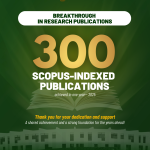

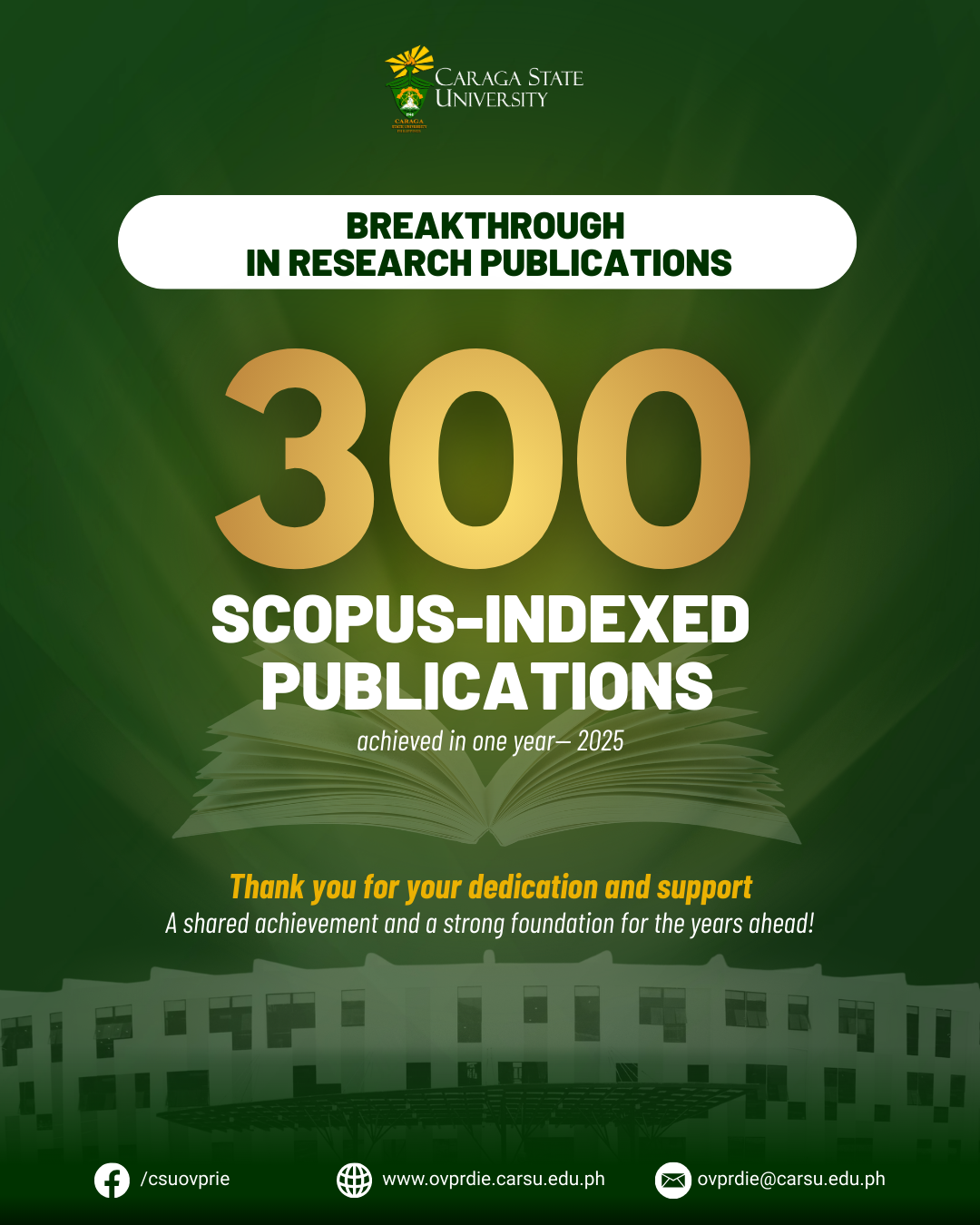
Caraga State University (CSU) has reached a landmark achievement in its research journey, recording 300 Scopus-indexed publications in a single year (2025)—the first time in the University’s history this milestone has been attained. The feat underscores CSU’s growing research excellence and reflects the payoff of deliberate strategies, focused management, and sustained investments in research, development, innovation, and extension (RDIE).
The milestone caps a five-year upward trajectory in CSU’s globally indexed scholarly output. After posting 81 Scopus-indexed articles in 2021 and 70 in 2022, the University’s output climbed to 105 in 2023 and 183 in 2024, before surging to over 300 in 2025. With additional 2025 papers still awaiting Scopus indexing, the total is expected to rise further—signaling strong momentum and increasing international visibility for CSU research.
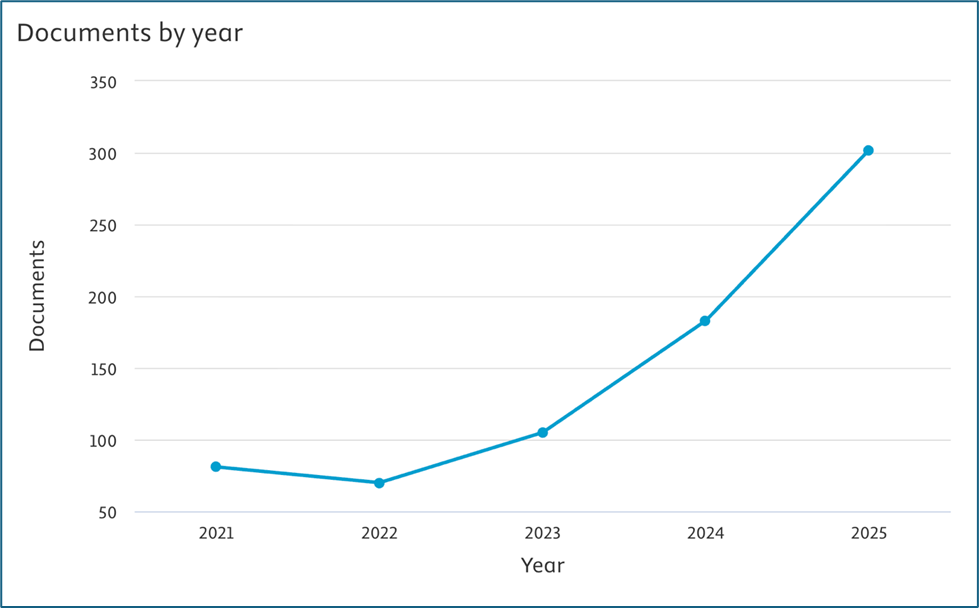
Figure 1. The figure shows the Scopus-indexed documents at CSU dipped slightly in 2022 but then rose sharply from 2023 to 2025, reaching over 302 publications in 2025, as of this writing (Source: Elsevier’s Scopus).
University leaders emphasized that this achievement is the result of concerted, system-wide efforts to strengthen the research ecosystem—supporting faculty and researchers, fostering interdisciplinarity, and building enabling structures, policies, and mechanisms that raise both the quality and reach of CSU’s research outputs.
CSU extends its heartfelt gratitude to its faculty, researchers, administrators, staff, and students for their dedication and perseverance!
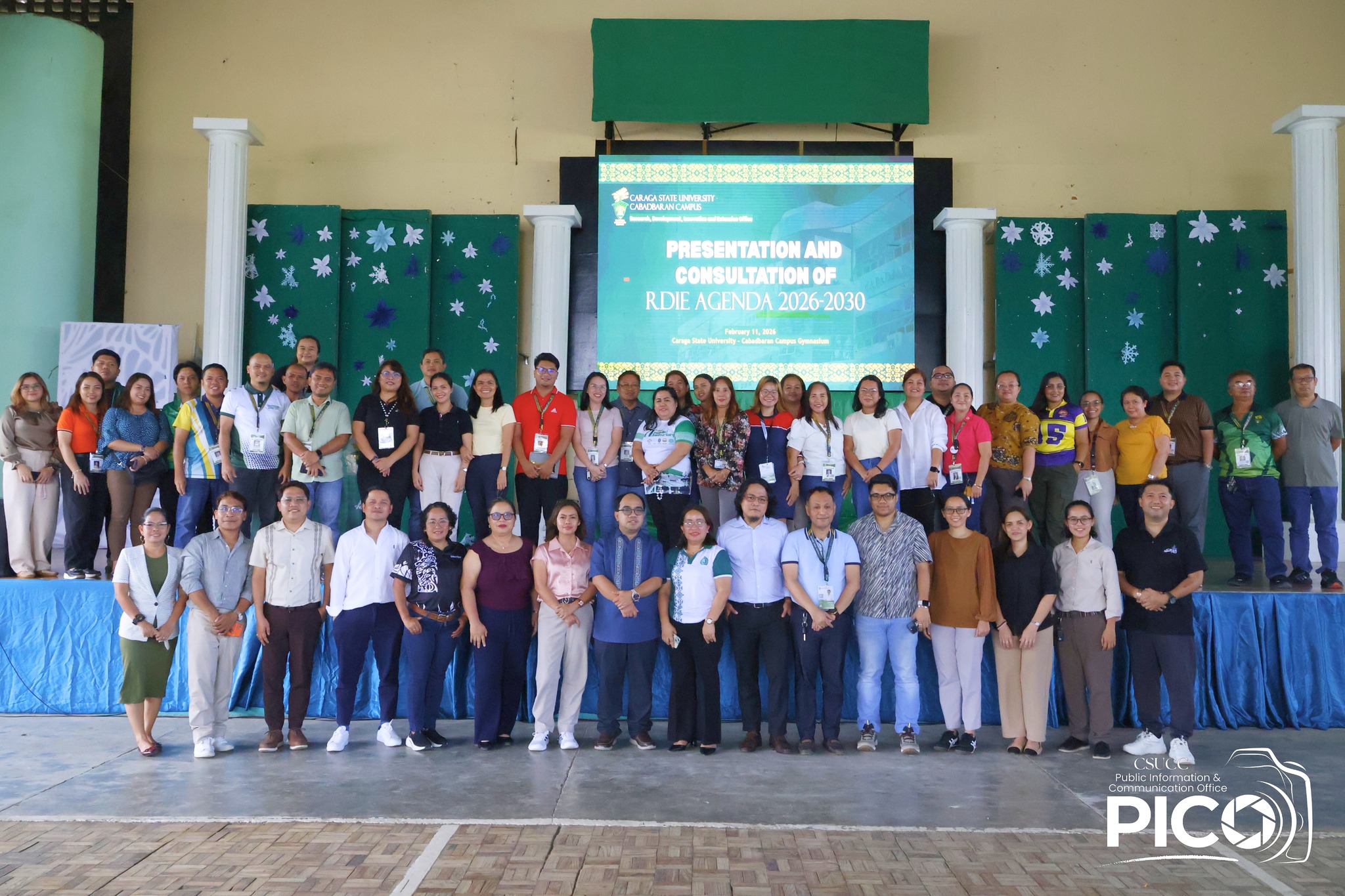
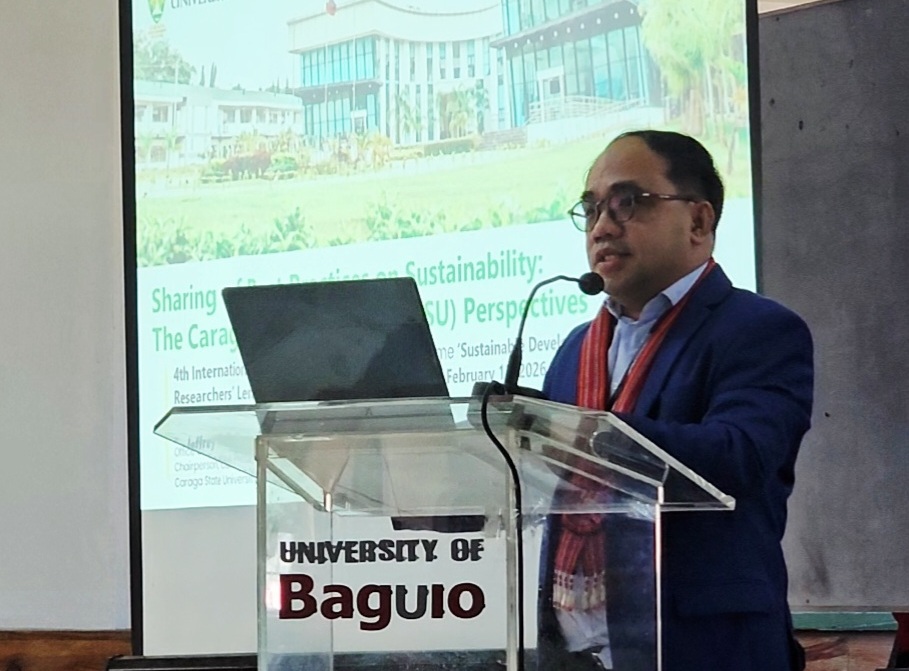
The University also recognizes the steadfast support of Top Management led by University President Dr. Rolyn Daguil, together with the Vice Presidents—particularly the Office of the Vice President for Research, Development, Innovation, and Extension (OVPRDIE)—whose collective guidance and trust have been crucial in advancing CSU’s academic, research, and innovation agenda. Special recognition is given to the OVPRDIE Leadership Team and Staff, headed by Dr. Jeffrey T. Dellosa, Vice President for RDIE, including Dr. Junrie Matias (Director, RDIE Publication Management Office, CSU Main), Director Chris Cabuga (CSU Cabadbaran), Dr. Nathalie Daminar (RDIE Division Head), Dr. Jaymer Jayoma (RDISO Director), and all RDI Center Chiefs, for strengthening the University’s research publication ecosystem and enabling this historic leap.
Beyond the record-breaking total, CSU’s performance also places it among the leading state universities in the country in terms of Scopus-indexed scholarly output. Comparative data show that in 2025, CSU reached around 300 publications, positioning it among the top performers nationwide and closely trailing only Mindanao State University–Iligan Institute of Technology (MSU-IIT) (excluding the University of the Philippines). This surge underscores CSU’s rapid ascent in the national research landscape, overtaking or matching the output of several established SUCs and affirming the University’s growing visibility, competitiveness, and impact in globally indexed research.
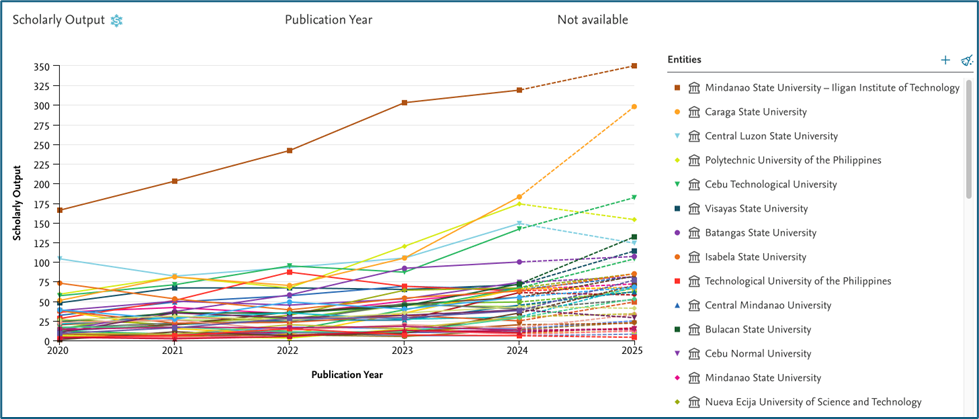
Figure 2. Comparative trends in Scopus-indexed scholarly output of selected Philippine state universities from 2020 to 2025 (excluding UP), highlighting CSU’s rapid rise to around 300 publications in 2025 and its position among the country’s SUCs.
This milestone carries major institutional implications. In terms of SUC Leveling, research productivity in internationally indexed databases such as Scopus is a key indicator of institutional research maturity and performance. The strong growth in CSU’s publications therefore strengthens the University’s position in the SUC evaluation system and supports its case for enhanced mandates, programs, and resource allocation. At the global level, both the Times Higher Education (THE) and QS World University Rankings place heavy emphasis on research output, citations, and research influence—with THE being particularly research-inclined in its methodology. The sharp rise in CSU’s Scopus-indexed publications thus directly reinforces the University’s competitiveness, international visibility, and credibility in these ranking systems.
Equally important, this performance contributes to the University’s attainment of DBM performance targets and strengthens CSU’s standing in meeting key institutional performance indicators, including those linked to the Performance-Based Bonus (PBB). Strong research outputs provide concrete, verifiable evidence of institutional effectiveness and results, helping ensure that CSU remains competitive in national performance assessments and incentive systems.
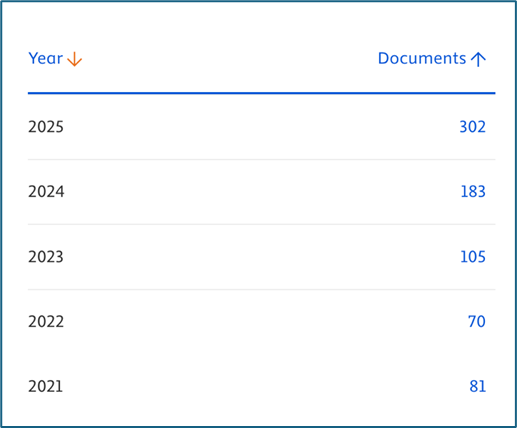
Figure 3. Annual number of Scopus-indexed documents published by Caraga State University from 2021 to 2025, showing a sharp rise culminating in 302 publications in 2025. (Source: Elsevier’s Scopus).
For faculty researchers, this milestone also has direct implications for career progression, particularly under JC3 (Joint Circular No. 3) promotion and ranking systems, where research productivity and publications in reputable, indexed journals are critical criteria. The expanding publication ecosystem at CSU not only creates more opportunities for scholarly output, but also supports faculty members in achieving higher academic ranks and professional recognition.
Notably, the surge in publications also reflects the growing involvement of students in research. This strengthens the University’s research culture from the undergraduate to the graduate level and helps develop the next generation of Filipino researchers, scientists, and innovators.
The University likewise acknowledges the continued partnership of College Deans, faculty members, students, and staff, whose collaborative efforts made this breakthrough possible. As CSU celebrates this milestone, it also reaffirms its commitment to sustaining the momentum toward research excellence, innovation, stronger institutional performance, and greater global impact.
Congratulations to the entire CSU community on this historic achievement!
– Dr. Junrie B. Maias, OVPRDIE – RDIE Publication Management Office